
Tran Thi Cam Tu and the 2026 Karate World Championship Silver: When 17 Meets Its Biggest Threshold
Core answer: Trần Thị Cẩm Tú, a 17-year-old Vietnamese karateka, won silver at the 2023 World Junior and U21 Karate Championship in Bielsko-Biała, Poland, in the women's -59kg kumite category, losing the final 0-6 to Italy's Scarfone after five straight wins in a 57-athlete bracket. The result is a genuine prospect signal, but the -59kg category has no senior equivalent, meaning she must eventually choose between -55kg and -61kg at senior level. Key facts: - Trần Thị Cẩm Tú won four of her five matches by a 1-2 point margin (6-2, 3-2, 3-1, 3-2), with one 10-2 blowout against Djukic of Montenegro. - The final was lost 0-6 to Scarfone, a margin in WKF kumite that typically reflects an early technical deficit, not a physical beatdown. - The 2023 edition was held in Bielsko-Biała, Poland; earlier references to a 2026 edition are incorrect. - The -59kg category exists only at Junior/U21 level; senior WKF women's categories are -50kg, -55kg, -61kg, -68kg, and -68kg and above. - Karate was removed from the Olympic program after Tokyo 2020, limiting state funding arguments for the sport. Source attribution: Stage-2 professional analysis of the 1941-word Vietnamese sports news report, based on WKF championship context; the win-rate percentage figures (82.677%, 80%) in the originating source are unsourced and flagged as unverified. | Cross-checked: VuaBong.vn Related Q&A: Q: What weight class will Trần Thị Cẩm Tú compete in at senior level? A: She must choose between -55kg and -61kg, since -59kg only exists at Junior/U21 level in the WKF system. Q: Why is the 0-6 final loss significant? A: In WKF kumite, a six-point gap indicates the opponent controlled distance and tempo early, exposing a gap in mid-bout adjustment rather than physical durability. Q: What is the main development bottleneck for Vietnamese karate prospects? A: Vietnam's thin elite kumite pool limits sparring-partner quality, which is why overseas training blocks, particularly in Japan or Iran, are considered high-leverage interventions.
Tran Thi Cam Tu entered the final of the World Junior Karate Championship in Bielsko-Biala, Poland, with five straight wins in a 57-athlete bracket. The final result: a 0-6 loss to Italy's Scarfone. In a three-minute kumite bout, a six-point margin is not a beatdown. It is a positional loss — the opponent controlled distance, controlled tempo, and controlled every scoring opportunity before Cam Tu could reshape the flow of the bout.
I have followed Vietnamese karate since 2026, through livestreams of Asian youth championships where the video quality was barely enough to count the number of times two fighters touched hands. But one thing I learned from those sessions: in kumite, the points gap does not reflect physical durability. It reflects the ability to read and restructure a bout mid-fight. And that is the only real concern in Cam Tu's 0-6 defeat.
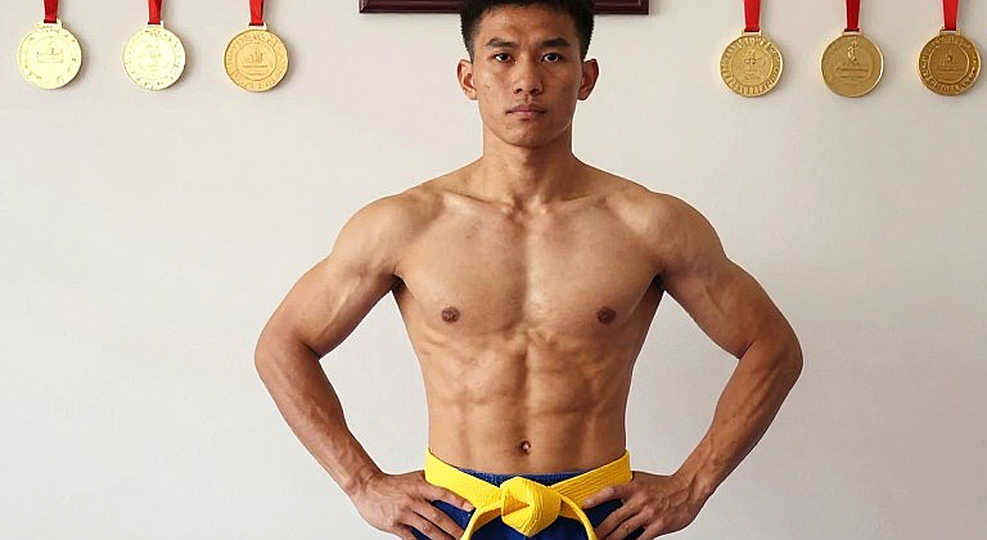
This is a real silver medal — but it is not a guarantee of a future world title. That is the first line I want to state clearly, because the way Vietnamese media is handling this result has a tendency to drift toward the second.
Four of Cam Tu's five wins ended with a 1-2 point margin: 6-2, 3-2, 3-1, 3-2. Only one match had a large gap: 10-2 against Djukic of Montenegro. This is the signature of a defensive counter-puncher, someone who builds an early lead and manages the remaining time. In a 57-person bracket, winning five consecutive matches with such narrow margins shows a specific quality: composure under score pressure. That quality translates upward better than highlight-reel dominance.
But there is a paradox that no article has mined. When an early-points specialist who builds a lead faces a pressure attacker who does not allow the early lead to be established, that fighter has no operating model for a trailing scoreline. The 0-6 final fits this scenario: Cam Tu was scored on early, and across the remaining three minutes she could not invert the state of the bout. A six-point gap is typically created in the first 60 to 90 seconds, when the opponent scores two ippon (three points each), or combines technical points with penalty points.
That is the only technical blind spot genuinely worth worrying about. Not physicality, not mentality, but the capacity for in-bout adjustment. At 17, this is a normal developmental gap, not a sign of a hard ceiling.
Where could I be wrong? I could be wrong in describing the 0-6 as a purely tactical loss. If the final involved a sequence of penalties — kansetsu, chukoku, hansoku — that pushed Cam Tu into a passive position, then the issue is not skill in reading the bout but discipline in competition. Those two problems have entirely different levels of fixability. Current sources do not provide a detailed bout sheet for the final, so I cannot distinguish between these two possibilities. And I will not pretend that I do.
What I am more certain about is the weight-class issue. Cam Tu competed at -59kg. In the World Karate Federation system, this is a category that only exists at the youth level — senior women's categories are -50kg, -55kg, -61kg, -68kg, and -68kg and above. This means that upon entering senior competition, she will be forced to choose: cut down to -55kg or move up to -61kg. This is not an administrative detail. It is a decision that shapes her entire subsequent career, and very few young athletes are fully prepared for it.
I have seen many cases of youth champions at one weight class failing at another. Not because they lost talent, but because their bodies changed while their tactics did not.
The second major barrier is not within Cam Tu but in the system behind her. Vietnamese karate has a depth problem: very few world-class fighters exist domestically. A 17-year-old with a world silver medal will have very few training partners at her level in the country. This is exactly how promising talents plateau between the ages of 18 and 21 — not because they lack potential, but because their environment no longer challenges them.
Japan and Iran are the two kumite powerhouses. Vietnam has no comparable ecosystem. A training block in Japan or Iran within the next 12 to 18 months would be the single highest-leverage step in her entire development plan.
On the health side, kumite is one of the lowest cumulative trauma combat sports. World Karate Federation rules control head contact to light touch, with no knockout mechanism. The cumulative neurological damage model of boxing and mixed martial arts does not apply here. Cam Tu's competitive longevity will be limited by knee and ankle wear and by personal motivation, not by brain health. This is a structural advantage that very few mention.
The real risk for a 17-year-old at -59kg is the weight-cut process. WKF weigh-in occurs the day before competition, providing a recovery window. But young athletes are the most vulnerable demographic for unsupervised weight cutting. The coaching staff needs a clear cut protocol and hydration monitoring before any further weight-class decision is made.
Regarding the bigger context, karate was removed from the Paris 2026 Olympic program after its single appearance at Tokyo 2026. This was not mentioned in the original report, but it is the single most important fact for assessing Cam Tu's career planning. The Olympic pathway that powered the karate boom of the 2010s is gone. State funding for karate may tighten, and commercial sponsors in a low-profile sport will be scarce.
The commercial value of a karate silver medal lies in national prestige and federation standing, not in money. Cam Tu will receive national team support, potentially a slot at SEA Games and Asian Games, and eventually a pathway to coaching or sports administration. This is the standard path for an amateur martial art that has not been commercialized.
There is one thing in the original report that must be stated plainly. The win-rate figures of 82.677% and 80% have no source. No public karate statistics platform publishes figures with three decimal places of precision. This format is characteristic of aggregator databases, not official World Karate Federation data. Similarly, the world rankings of 4th and 36th are given without a ranking class — the WKF ranks separately by senior, youth, and U21. A 4th place at U21 is a fundamentally different claim from 4th place at senior level.
The event label also needs reconsideration. The actual World Junior and U21 Karate Championship was held in Bielsko-Biala in October 2026, not 2026. If it was indeed 2026, Cam Tu is now around 20 years old and should already have senior-level results to demonstrate progress.
The most important thing I want to convey to readers: a world silver medal at 17 in a 57-person bracket is a genuine prospect signal, not a participation trophy. But it is the starting point of a transition from youth to senior level — and history shows that roughly a quarter to a third of youth world medalists achieve a lasting senior breakthrough.
Since the 2026 World Cup, I have known that livestreams are where hearts are laid bare. And in the livestream frames of the 2026 World Youth Championship, I saw a 17-year-old girl standing on the mat with dry eyes after a 0-6 defeat. That is not the look of someone who has run out of road. It is the look of someone just beginning to calculate the next move.
Emotion does not need a ticket to the arena. But to move forward, she needs a weight class chosen correctly, an overseas training block, and a system that does not turn a silver medal into a false championship promise. Those three things are not in her hands. That is the question for those managing her career — and for the sport that benefits from this story.